test
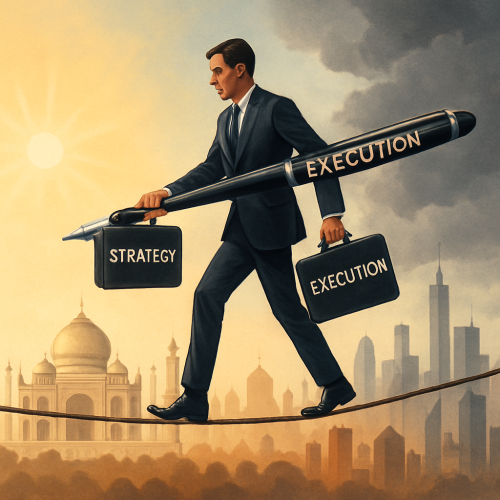
In the glittering glass towers of Bengaluru and Mumbai, a silent war rages between dreamers and doers. On one side, bold-eyed CXOs paint visions of AI revolutions and global domination. On the other, weary CFOs clutch their spreadsheets, whispering about unit economics and compliance risks. The battleground? India's $4 trillion corporate landscape, where spectacular ambitions keep colliding with hard execution truths.
The Grand Delusion: When Strategy Loses Touch with Reality
Take the cautionary tale of Byju's, once the crown jewel of India's startup ecosystem. In their quest to build the Amazon of education, they went on a $4 billion acquisition spree, snapping up companies across three continents while their core product languished. The marketing team signed Lionel Messi for $100 million annually even as teachers went unpaid for months. The result? A spectacular 95% valuation crash, layoffs of 10,000 employees, and the unenviable distinction of becoming India's most expensive business school case study on execution failure.
Not far away, Ola Electric was scripting its own tragedy of misplaced priorities. Their $500 million "Futurefactory" - billed as the world's largest e-scooter plant - became a monument to operational hubris. While the leadership team obsessed over robotic assembly lines and viral marketing campaigns featuring Bollywood stars, they overlooked basic battery safety and supply chain fundamentals. The consequence? A string of battery fires, massive delivery delays, and thousands of cancelled bookings.
The Marketing Mirage: When Hype Masks Hollow Execution
India's corporate history is littered with brands that mistook advertising budgets for strategy. Consider Micromax, which in 2015 blanketed the country with IPL ads featuring Hugh Jackman, while Chinese competitors quietly built superior products and distribution networks. Their marketing spend could buy prime-time visibility but couldn't purchase customer loyalty when better options arrived.
Then there was Snapdeal's infamous "Unbox Zindagi" rebrand - a ₹200 crore exercise in corporate self-delusion. Overnight, they abandoned their value-conscious core audience to chase Amazon's premium customers, with Aamir Khan ads showing urban millennials unboxing designer watches. Meanwhile, their logistics network crumbled, delivery times stretched, and sellers defected en masse to Flipkart. The campaign won advertising awards even as the company lost 80% of its market share.
The Survivors' Playbook: Bridging the Strategy-Execution Chasm
Amidst these spectacular implosions, a handful of companies demonstrate how to walk the tightrope successfully. Zomato's remarkable turnaround shows the power of ruthless execution focus. When their global expansion strategy faltered, they didn't double down on vanity metrics. Instead, they made the painful but necessary decision to exit 13 countries overnight, using the savings to build Blinkit into a profitable quick-commerce engine.
Nykaa's story offers another masterclass in strategic discipline. While competitors chased GMV growth through deep discounts, founder Falguni Nayar maintained an almost religious focus on premium beauty margins. Their marketing dollars went not to celebrity endorsements but to building India's most sophisticated beauty influencer network. The result? Profitability in an industry where losses were considered inevitable.
Even the mighty Tatas provide lessons in course correction. Their ambitious Neu superapp stumbled initially under the weight of too many features and too little integration. But unlike Byju's, they paused to fix the plumbing - first integrating BigBasket's supply chain, then layering on services. It was slow, unglamorous work that doubled user retention within a year.
The New Rules of Strategic Execution
The Path Forward
As Infosys founder Narayana Murthy often reminds us, "Vision without execution is hallucination." The coming decade will belong to organizations that can match their ambition with operational grit - companies where:
The alternative? More empty "Futurefactories," more unicorn down-rounds, and more case studies about how not to build enduring businesses. In India's next chapter of growth, the winners won't be those who dream the biggest dreams, but those who can turn their visions into daily operational realities - one unglamorous, spreadsheet-filled meeting at a time.
For every corporate leader staring at a bold new strategy today, the question isn't whether the idea is brilliant - but whether their organization has the discipline to make it real. Because as India's corporate dramas keep reminding us, the distance between vision and reality is where fortunes are made... and lost.

Copyright © Dixsam Consulting